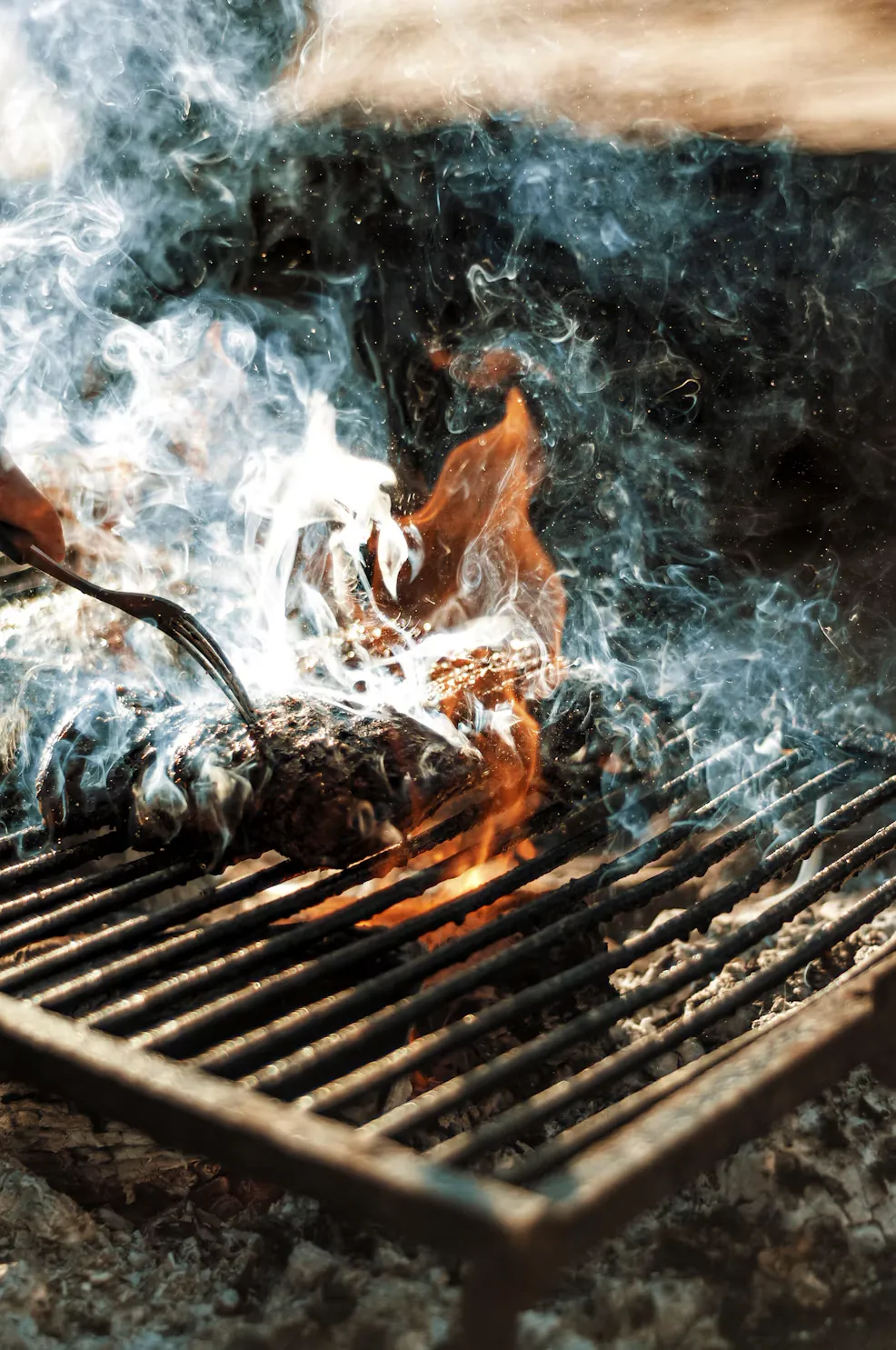
The reverse sear: embers last
A thick rib steak, coaxed first away from the embers, then thrown over a roaring fire for a dark, crackling crust. The numbers that matter, and where they come from.
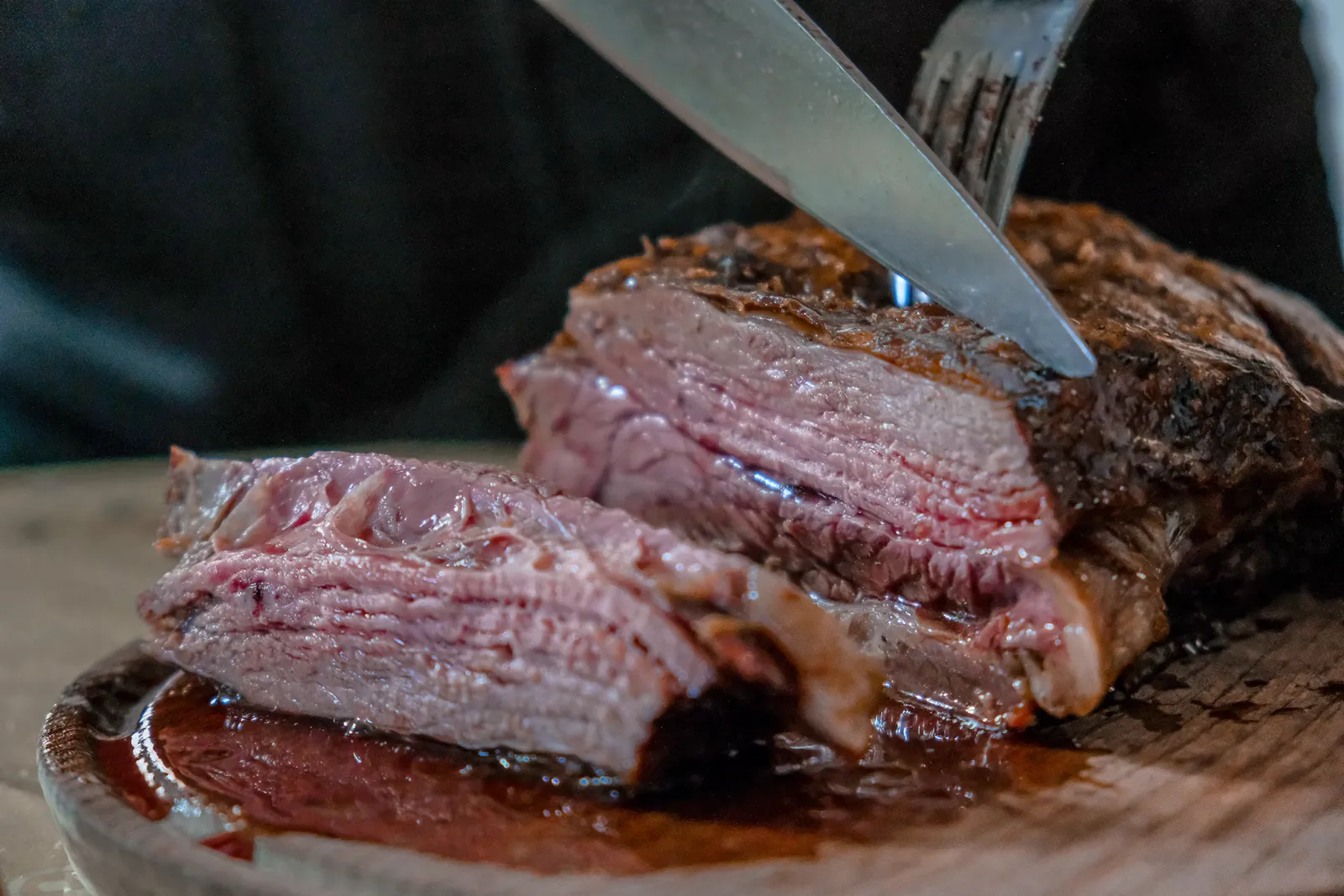
A thick rib steak can't be rushed. The classic method throws it on a roaring fire first for the crust, then lets it finish. The reverse sear turns that around: gentle heat first, away from the embers, until the centre is close to where you want it; only then the fierce heat, for the crust.
It asks for one thing: a thermometer, and the patience to trust it over the colour.
Why sear at the end
Searing first does not "seal in the juices". That is a myth, as the sources we consulted point out1. A crust brings flavour and texture, not a seal.
That is the whole idea of the method: bring the centre close to your target over gentle heat, then ask the embers for nothing but the crust. The time over the hot fire then shrinks to a few minutes23.
Which cuts
The method is made for thick cuts, at least 3.8 cm (1.5 in)123. Thinner than that, the difference from a classic sear becomes small, and the meat cooks too fast to benefit3.
The numbers, and where they come from
The sources we consulted don't all give the same numbers. Here they are, as published:
- Gentle zone: about 107 °C (225 °F) on the grill2, or 107–135 °C (225–275 °F) according to another source3. In the oven, one source goes as low as 93 °C (199 °F) for about an hour1.
- When to move over the embers: when the centre reaches 43–46 °C (109–115 °F)2, roughly 5 to 8 °C (10 to 15 °F) below your final target13.
- Sear: hot fire, flipping often, 1 to 3 minutes per side depending on how hot the embers are23.
The safety point
The reverse sear is often presented with "medium-rare" finishing temperatures, between 52–57 °C (126–135 °F) depending on the source12. Those numbers are a matter of taste.
The official US benchmark for a whole cut of beef is 63 °C (145 °F) inside, followed by a 3-minute rest off the heat4. Health Canada also gives 63 °C (145 °F) for medium-rare, and reminds you that mechanically tenderized beef must reach that temperature while being turned at least twice5.
We won't tell you that less-cooked meat is risk-free: that is not what the authorities say. The choice is yours, made with the facts in hand. All the official numbers are on our Safe cooking temperatures page.
The fire curve
Times are indicative: the thermometer decides.
The method
Ingredients
- 1 rib steak or ribeye at least 3.8 cm (1.5 in) thick
- coarse salt
- a probe thermometer (essential)
- lump charcoal or hardwood, for a two-zone fire
Set up two zones
Push the embers to one side of the grill. The side without embers is for gentle cooking: aim for about 107 °C (225 °F) under the lid2.
Salt
Salt the meat on every side.
Cook gently
Place the meat on the side without embers, lid closed, probe in the centre of the thickest part. Wait for 43–46 °C (109–115 °F) inside2. Expect around thirty minutes, but the thermometer decides2.
Timer : about 30 min
Sear
Open the lid and move the meat over the hottest embers. Flip it every minute until the crust is deeply browned, usually 1 to 3 minutes per side23.
Timer : about 1 min
Check the temperature
The official benchmark for a whole cut of beef is 63 °C (145 °F) inside, followed by a 3-minute rest4. Many cooks stop earlier for taste, between 52–57 °C (126–135 °F) depending on the source12: that is a preference, not a safe value.
Serve
Slice and serve hot. If you are aiming for the official benchmark, give it the 3-minute rest off the heat first4.
Sources
Every number and fact on this page points to one of these sources.
- Specialist pressHow to Master the Reverse Sear SteakWilliams Sonoma, Taste (blog) · accessed November 11, 2026
- Specialist pressThe Perfect Grilled Steak RecipeAmazingRibs.com · accessed November 11, 2026
- Specialist pressHow to Reverse Sear Steak on a GrillBBQGuys · accessed November 11, 2026
- Official sourceSafe Minimum Internal Temperature ChartFoodSafety.gov (US government) · accessed November 11, 2026
- Official sourceSafe cooking temperaturesHealth Canada · accessed November 11, 2026
Keep exploring
Safe cooking temperatures: what the authorities actually say
Over the embers, colour lies; the probe doesn't. The US and Canadian internal temperatures side by side, and where they disagree.